How to get your hardscaping company to the top of Google
This is the whole playbook. The website, the Google Business Profile, the reviews. It is everything we do for hardscapers, written so you can do it yourself.

Why the top spot matters
It is not about rankings. It is about the phone ringing.
When a homeowner decides to finally build that paver patio or fix the sloped backyard with a retaining wall, they search "paver patio contractor near me" and study the results. They look at photos, read reviews, and shortlist two or three companies.
Google shows a map with three companies on it. That box is called the map pack. Those three get most of the estimate requests. When one patio or outdoor living project can be a five-figure job, being in that box changes your whole season.
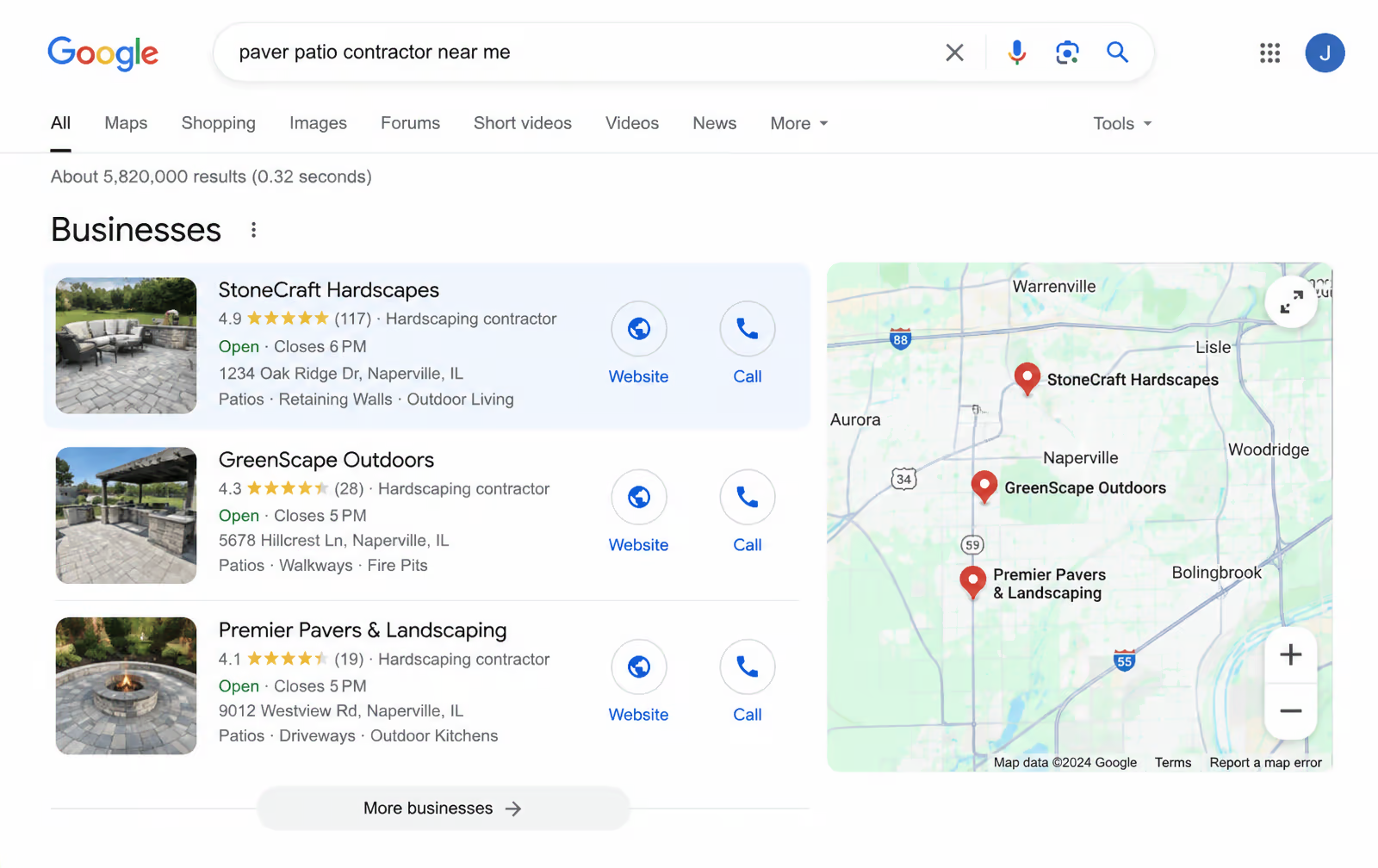
Google picks those three based on distance, how well you match the search, and how trusted you look. You cannot change where you are based. The other two are completely in your control. That is what this guide covers.
Build a website Google can understand
Your website tells Google what you build and where you build it.
Most hardscaping websites are one page with a logo, a phone number, and "Patios, Walls and More." The problem is Google reads your website like a list of answers. If your site never says "paver patio in Naperville," Google has no reason to show you to the homeowner searching exactly that.
Build one page for every project type
Every project type you want more of gets its own page. Someone pricing a small walkway has different questions than someone planning a full outdoor kitchen, and Google treats those as different searches.
- Paver patios
- Retaining walls
- Walkways and driveways
- Fire pits and outdoor fireplaces
- Outdoor kitchens
- Seat walls and pillars
- Drainage solutions (if you do them)
Each page should answer what a homeowner would ask on a site visit. What materials do you recommend and why? How do you handle base prep so it does not settle? How long does a project like this take? Write it like you talk.
Show your projects like a portfolio
Hardscaping is a visual, trust-heavy business. Homeowners want to see finished patios and walls before they commit. Put real project photos on every page, with a sentence or two about each one: the town, the materials, the scope. This helps homeowners and gives Google more to understand about your work.
Build one page for every town you serve
If you cover five towns, build five town pages. "Paver Patio Contractor in Naperville, IL." Make each one different: mention the neighborhoods, the soil and slope issues you see there, the projects you have done. Copy-pasting one page and swapping the town name does not work. Google can tell.
Get the basics right on every page
- 01Page title
The title in Google should say the project and town. "Paver Patios in Naperville, IL | StoneCraft Hardscapes." Not "Home."
- 02One clear headline
The big headline should match the title so people know in two seconds they are in the right place.
- 03Phone number at the top
Tap-to-call on phones. Many homeowners browse on their phone from the backyard they want to fix.
- 04A text option
People love texting a photo of their yard for a ballpark. Let them. Every text is a lead you would have lost.
- 05Real photos
Your finished patios, your crew at work. Real photos beat stock photos every time.
- 06Fast loading
If your site takes more than a few seconds on a phone, people hit back and call the next contractor.
- One page that says "We do it all"
- Stock photos of patios you did not build
- Phone number buried at the bottom
- A long contact form with 12 fields
- Identical text on every town page
- A page for each project type and each town
- A portfolio of your real finished projects
- Tap-to-call and text at the top
- A short form: name, phone, what you want to build
- Town pages that mention real neighborhoods
Keep your name, address and phone identical everywhere
Your business name, address and phone should be written exactly the same on your website, Google profile, Facebook, and anywhere else. "StoneCraft Hardscapes" on one and "Stone Craft Hardscaping LLC" on another makes Google less sure they are the same business. Pick one version and use it everywhere.
Set up your Google Business Profile the right way
This is the listing in the map. For hardscapers, it matters more than anything else.
Your Google Business Profile is the box that shows your name, stars, phone and hours in the map. It is free, and it is the single biggest factor in whether you show up in the map pack. Most hardscapers set it up once and never touch it again. That is your opening.
Pick the right categories
Your main category should be "Hardscaping contractor" or "Landscape contractor," whichever Google offers that fits best. Then add extra categories only for work you really do: "Paving contractor," "Masonry contractor." Do not add categories for work you do not do. It can hurt more than help.
Fill in every single section
- 01Services
Add every project type with a short description: patios, retaining walls, walkways, fire pits. Use the words homeowners actually search.
- 02Service area
List the towns and zip codes you actually cover. Hide your address if you work out of your house or a yard.
- 03Hours
Set your real hours. If you do weekend estimates, say so.
- 04Description
In plain words: what you do, where, and what makes you different. Mention your main services and towns naturally.
- 05Website link
Point it to your homepage, or to a project page if you have one strong focus.
Post photos every week
Hardscapers have some of the best photo content of any trade. Upload photos every week: base prep, pavers going down, the finished patio with furniture on it. Profiles with fresh photos look alive and busy. Profiles with three photos from 2019 look closed.
Use Google posts like a mini Facebook
Once a week, post a project update with one photo and two sentences. "Finished this paver patio and seat wall in Naperville. Four days start to finish." It shows Google you are active and gives homeowners a reason to click.
Get more 5-star reviews (without being weird about it)
Reviews are how Google, and homeowners, decide who to trust.
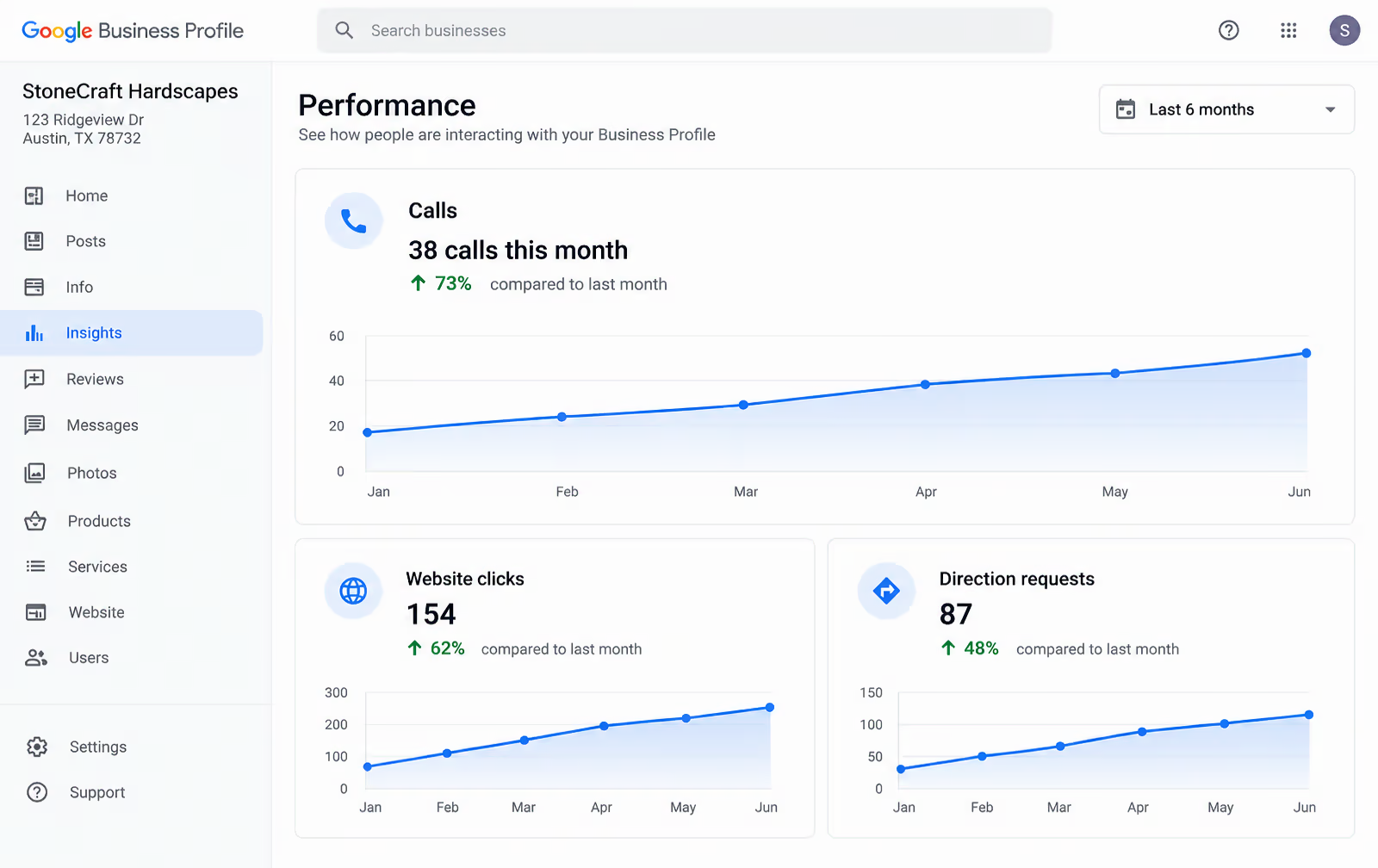
A homeowner about to spend real money on a patio reads reviews carefully. One company has 6 reviews, another has 117 detailed ones. Who gets the estimate request? Reviews are the trust signal for people and one of the biggest ranking signals for Google. The companies at the top almost always have the most recent reviews. Not just the most. The most recent.
Ask at the right moment
Timing is everything. Ask when the customer is happiest. For hardscapers, that is usually:
- At the final walkthrough when they see the finished patio
- The first weekend they host friends on it
- After a retaining wall fixes the drainage problem they fought for years
- When they tell you the neighbors keep asking who built it. That is your cue.
Make it one tap
Nobody is going to hunt for your review page. Send the direct link by text. You can get it from your Google Business Profile under "Ask for reviews." Text works far better than email because people actually read texts.
Reply to every review
Reply to every review, good and bad, within a couple of days. For good ones, thank them by name and mention the project: "Thanks Mike, glad the patio is already the family hangout." For bad ones, stay calm, say you want to make it right, and give a phone number. Future customers read your replies more than you think.
How many do you need?
Look at the top three hardscapers in your area. Count their reviews and check how recent they are. That is your target. Hardscaping companies usually have fewer reviews than high-volume trades, so even a steady two or three a month puts you ahead fast.
Keep it going and track what works
This is not a one-time job. Small, steady work wins.
Getting to the top is not one big push. It is a few small things every month while your competitors do nothing. Here is the simple monthly checklist we follow for hardscapers.
- 01Every project
Take progress and finished photos. Text the review link at the final walkthrough.
- 02Every week
Upload photos to your Google profile. Make one Google post about a project.
- 03Every month
Reply to all new reviews. Add one finished project to your website portfolio.
- 04Every month
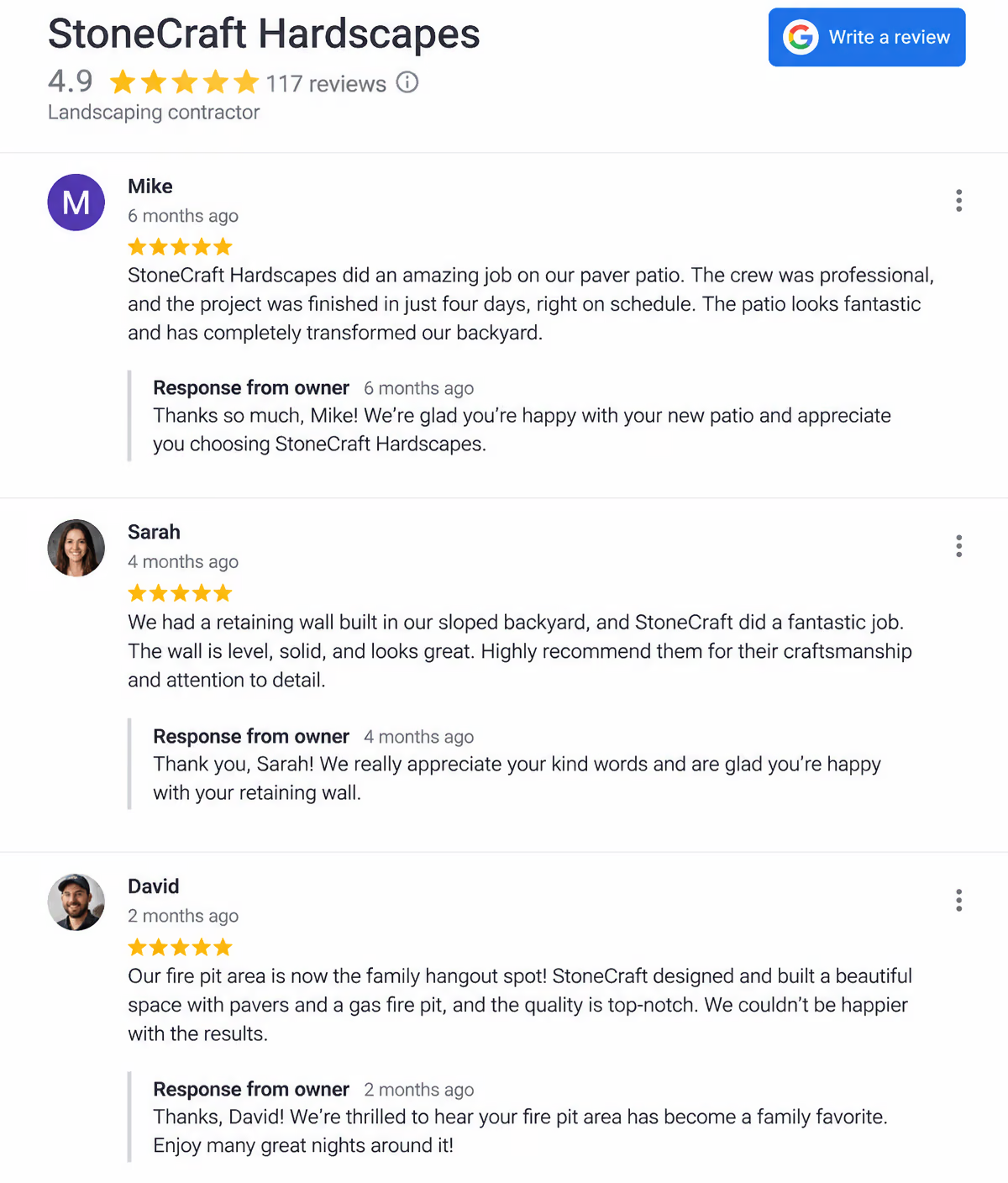
Check your Google profile numbers: calls, website clicks, direction requests.
- 05Every few months
Search "paver patio contractor near me" from a few spots in your area and see where you show up.
How to tell if it's working
Don't judge by a feeling. Look at "Performance" in your Google Business Profile. You want calls and website clicks trending up. Also ask every new customer how they found you and write it down. When "Google" shows up more and more, it is working.
Be patient. Hardscaping searches are fewer but each project is worth more, so even a slow climb pays off. No one can promise you a specific spot on Google, and be careful of anyone who does.
Common questions
What is hardscaping SEO?
It means making it easier for homeowners to find your hardscaping company on Google. Mostly that is your website, your Google Business Profile, and your reviews.
How long does hardscaping SEO take to work?
It depends on your area and competition. Many companies see movement within a few months of steady work. Nobody can promise a specific Google spot.
Do I need a website if I have a Google Business Profile?
Yes. Your website is your portfolio. Homeowners want to see finished patios and walls before they book an estimate, and Google uses your site to understand your work.
What category should a hardscaper pick on Google?
Use "Hardscaping contractor" or "Landscape contractor" as your main category. Add extras only for work you really do, like paving or masonry.
How do I get more Google reviews for my hardscaping company?
Text every customer your review link at the final walkthrough, when they are looking at the finished project. Reply to every review you get.
Can I do hardscaping SEO myself?
Yes. Everything in this guide can be done by you. If you would rather spend your time building, we can handle it, starting with a free website.
Should I pay for Google Ads instead?
Ads can bring estimate requests fast, but they stop the day you stop paying. Ranking in the map keeps bringing them. Many hardscapers do both.
Hey, I'm Ayush.
I've helped contractors of all kinds get to the top of Google: roofers, HVAC companies, plumbers, landscapers, tint shops and more. Every website I build and every Google profile I set up has one goal: get you more calls so you book more jobs.
This guide is exactly what I do for my clients. If you'd rather spend your time on roofs, I'll build your website for free in 2 hours and take it from there.
YOUR HARDSCAPING COMPANY.
#1 ON GOOGLE.
Free website in 2 hours. Then we help you climb the map.